Meric Altug
Gemalmaz

I work at Meta as an ML Research Scientist, currently in the Meta AI Org in Menlo Park, California. I joined Meta in August 2025, after finishing my Ph.D. at Purdue, where I studied bias and fairness in AI: whether AI treats people fairly, and how people react to it and use it.

Illustrated portrait of Meric Altug Gemalmaz
ML Research Scientist, Meta AI Org · since Aug 2025
Ph.D. in Computer Science, Purdue University · completed June 2025

My PhD followed the machine learning pipeline from the data people create, through the models that data shapes, to the model decisions people experience. At Meta I build that pipeline itself, for real users, from ranking what people see to the data models learn from.

The loop

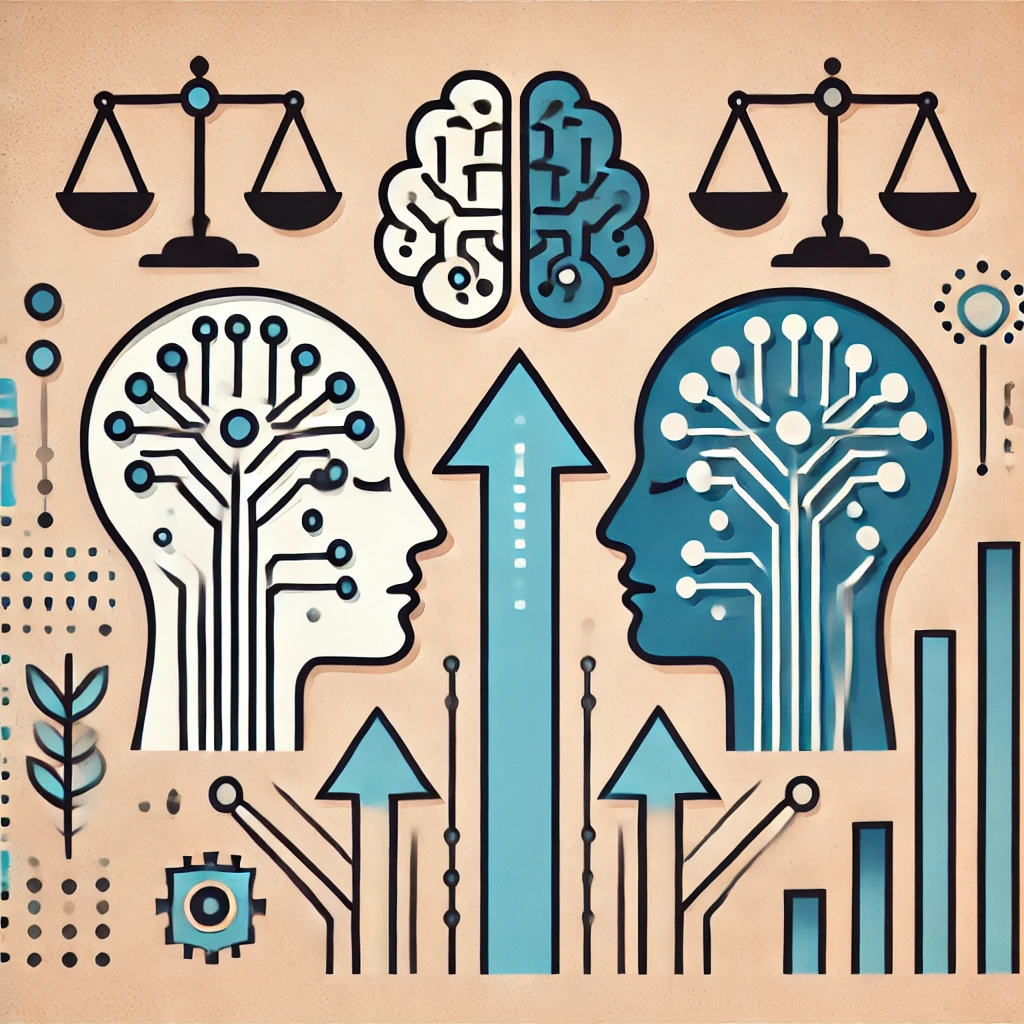
My experience at Meta and in my Ph.D. can be summarized by this loop.

People create data. A model learns from it and makes decisions about people. People react to the decisions made about them, and their reactions are collected as data and used to update the model again, so the cycle starts again.

Jun 2026 — Present

Meta AI Org

I help AI systems become better (SOTA). At Meta AI, I work on the data that AI models learn from: improving the data we already have, and creating new data for models to learn from. I also build the step-by-step tools and workflows that make this work possible, and evaluate AI agent systems.

Aug 2025 — Jun 2026

FB Groups – Distribution

  • Built the recommendation systems that decide what people see in Groups: the Groups suggested to them, and posts suggested from Groups they have not joined.
  • Raised the quality of those posts with the generators that suggest them, and with signals and value models that show good posts more and bad posts less.
  • Improved both ranking stages of that funnel, early, when posts are first considered, and late, when the final order is set — the value models work at both stages.
  • So good posts reached more people across Groups and Feed, and more people found them and responded to them.
Understandingstudy people Modelingbuild & change

Papers

My dissertation and four papers, in the order they connect
Group by theme
Thumbnail for the IJCAI 2021 paper on confirmation bias in crowdsourced label aggregation
IJCAI 20212021Dissertation Chapter 2Modelingbuilt a model

Theme · Crowdsourcing — labels from many people

Accounting for Confirmation Bias in Crowdsourced Label Aggregation

Meric Altug Gemalmaz and Ming Yin

Quick recap: When labels come from many people, each person's confirmation bias comes with them — the tendency to favor what they already believe. The model in this paper estimates each annotator's bias and corrects for it while combining the labels, so the result is substantially less biased.

The 30th International Joint Conference on Artificial Intelligence (IJCAI), Online, August 2021.

Thumbnail for the AIES 2022 paper: a person and an AI agent in a circular exchange
AIES 20222022Dissertation Chapter 3Understandingstudied people

Themes · Fairness · People and AI

Understanding Decision Subjects' Fairness Perceptions and Retention in Repeated Interactions with AI-Based Decision Systems

Meric Altug Gemalmaz and Ming Yin

Quick recap: When people face an AI's decisions again and again — here, loan decisions — what shapes their fairness judgments, and whether they stay or leave, is less whether the system treats every group the same and more whether it favors their own group. For the people a system decides about, fairness is judged from where their own group stands.

The 5th AAAI/ACM Conference on AI, Ethics, and Society (AIES), Oxford, UK, August 2022.

Thumbnail for the paper on engagement and perceived fairness when qualification improvement opportunities exist
arXiv Preprint2024Dissertation Chapter 4Understandingstudied people

Themes · Fairness · People and AI

Understanding Decision Subjects' Engagement with and Perceived Fairness of AI Models When Opportunities of Qualification Improvement Exist

Meric Altug Gemalmaz and Ming Yin

Quick recap: Across three experiments, when people had a real chance to improve their qualifications, an AI's unfairness did not reduce their engagement or their effort to improve. But it did not soften their judgment either: when the AI treated their own group worse than the others, people still saw the system as less fair.

Thumbnail for the dissertation chapter on how people react when an AI keeps changing who gets which task
Dissertation Chapter2025Dissertation Chapter 5Understandingstudied peopleModelingbuilt a model

Themes · Fairness · People and AI

An Investigation of Decision Subjects' Interaction With Periodically Updated ML-Based Task Allocations

Meric Altug Gemalmaz and Ming Yin

Quick recap: When an AI hands out tasks and keeps updating who gets what, people are not reacting to a single decision but to a moving series of them. This chapter follows how people respond as the allocations keep changing, and how their sense of the system's fairness forms along the way.

Timeline

August 2025

I joined Meta. The work I have done since then is shown in The loop, above, where my Meta roles sit alongside the loop diagram.

June 2025

I finished my Ph.D. from the Department of Computer Science at Purdue University.

November 2023

I passed my early Ph.D. exam (called the preliminary exam).

November 2022

I received the Graduate Teaching Award for my teaching in CS 57300.

April 2022

Our paper on what people think is fair, and whether they stay was accepted to AIES 2022. Work done with Dr. Ming Yin.

April 2020

I was awarded the Raymond Boyce Graduate Teaching Award for my teaching in CS 25000 in the Fall 2019 semester.

January 2020

My department approved my request, and I officially became a PhD student.

December 2018

I earned my bachelor's degree in Computer Science, with honors, from Purdue University.